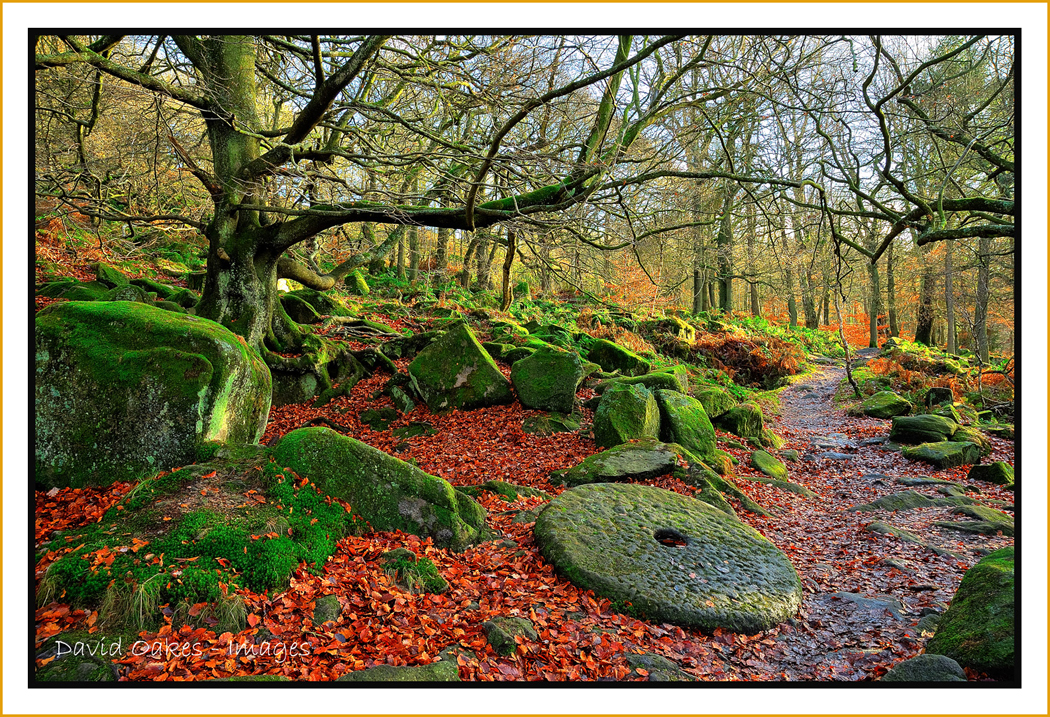
Location:- Millstones in Padley Gorge, The Derbyshire Peak District, England
23rd September
(C) David Oakes 2015
An Occasional Diary of Everyday Life and Travel in the U.K. and sometimes elsewhere

Location:- Millstones in Padley Gorge, The Derbyshire Peak District, England
23rd September
(C) David Oakes 2015
Comments are closed.
 DAVID OAKES - IMAGES.
Absolutely beautiful picture! Thanks for sharing!
LikeLiked by 1 person
i love this bright edit … it’s really a fantastic photo!
LikeLiked by 1 person
In truth it is tweaked a little but not by that much…the low winter light really made the lichen and leaves pop…I just gave it a little tweak and lightened the shadows
LikeLike
One can see that the photo is almost perfect on it’s own … that’s why I felt that the editing was so well done! 🙂
LikeLike
Old millstones, that is interesting for me who comes from a Norwegian millstone-producing village. Nice photo David!
LikeLike
If only this place and the quarry nearby could talk…they would tell a few tales. But as it is, its a little bit of history.
LikeLike
A really magical image, David. 🙂
LikeLiked by 1 person
I love this. All of the moss and green. Enchanting.
LikeLiked by 1 person
What are the millstones doing there? Some kind of ancient site, perhaps? Lovely photo.
LikeLiked by 1 person
Hi Jo….This whole area of North East Derbyshire was one big open air workshop (1700 thru early 1800). It was here because of the Gritstone Edges and Rocky valleys. (hence the local name originated.. of Millstone Grit). The Millstones were carved out of the rocks where the rock looked suitable and transported once completed (if they were completed as many shattered during the carving). Some rock cliff faces in the valleys became quarries and production looked more organised but still all were hand cut with chisels and hammer. Some place you can find rows of Millstones abandoned….which brings us to the question why abandon a finished stone. Well its all down to the French who invented a new style of Millstone which instead of one big stone was a stone cut in segments and bound together with an iron band….much cheaper to make and could even be repaired. So the bottom fell out of the Millstone market virtually overnight and these stones were just left as they were. The one in this image is in Padley Gorge. But its quarry history continued thru to the mid 1940 as stone was quarried from her to build the large dams on the Ladybower Reservoir system….. there was even a train line and incline. But today you have to search for those remnants of industry as Padley Gorge is now a Nature Reserve. Nature truly having taken back the gorge…most of todays visitors enjoy the gorge and explore unaware of its past very busy industrial life
LikeLike
As a P.S. to my earlier reply. take a look at the Blog for 1st October. Towards the end of that you will see more comment on Millstones and how they got to where they are..
LikeLiked by 1 person
OK, admit it: Using this image as a Wordless Wednesday entry was just bait for someone like Jo to swallow it and ask the pertinent question, to which you could reply with your usual historical expertise. Glad you did, David–it’s fascinating history, and yes, a wonderful, classical image, too. I see that autumn is really settling in for you.
LikeLiked by 1 person
Honesty time….this was last December. Favourite Places shots have more often than not to be from the archive. Glad you liked the follow up comments
LikeLike