

Magpie Mine, Sheldon, Derbyshire Peak District
The Derbyshire Peak District is a National Park and an area of Natural Beauty, a holiday destination and a weekend ‘playground’ enjoyed by thousands. So an industrial scene is not one that you would necessarily expect to find. Magpie Mine is, or rather was, a Lead Mine. The site as defined today dates back to the 174o’s and was worked with varying degrees of success and good fortune till its final closure in 1954. But I suspect, that like many locations across the Derbyshire Peak, Lead mining had been taking place for many hundreds of years earlier….after all the Romans considered the Peak’s Lead as a much prized commodity to trade with.
Nor was Magpie Mine the only one in this immediate location. There were several Lead Veins with names like Bole Vein and Red Soil Vein that were actively worked. The close proximity of these veins and the two mines, in particular Red Soil Mine and Magpie Mine, caused many disputes and hostilities. The real trouble came underground where shafts and workings were broken into from adjoining seams.
Fights we are told were common but one day in 1833, the miners from Magpie Mine took more drastic action. They set fires in the underground workings to smoke out the miners from Red Soil Mine with tragic consequences. 3 Miners were suffocated. A large number of Magpie Miners were arrested. 3 were charged with murder, but acquitted due to the difficulty of identifying the actual miners who set the fire.
There is also a story that a wife of one of the murdered miners placed a curse upon the mine….It is known locally as the “Widows’ Curse”. Whilst the fortunes of lead mining have always had there ups and downs one thing is said that Magpie Mine, despite being worked till 1954, never prospered again.
The buildings you see above are of course not as old as the mine itself. Dating from the mid 1800’s in various attempts to improve productivity, but mainly to drain the mine of water which had always been its real curse, pump houses with tall chimneys were built for Steam Pumps. With the pumps also came other mechanisation such as power winches and drills. I suspect they never fully repaid there investment.
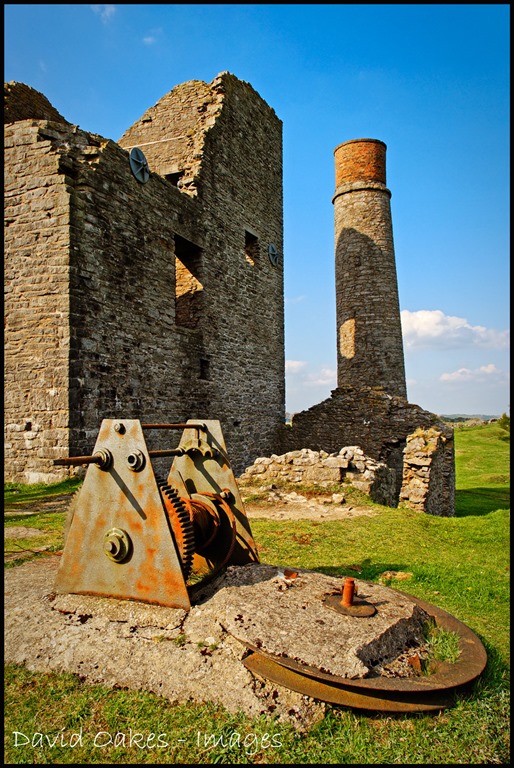
Far from being a ‘blot on the landscape’ these and other workings add a vital character and a link to an age when Derbyshire was heavily industrialised as opposed to a tourist destination.
Footnote: Today many Farmers are encouraged to diversify…well in my view they always have. Many of the mines of Derbyshire were mines opened and worked by farmers. In fact there are many now deserted farm houses, where in the corner of the living room, a mine shaft can be found. The logic was that if the owner lived above his mine shaft no one could steal his lead. Farmers also became transporters of the lead and ultimately transport carriers of much else.
20th February
© David Oakes 2014
 DAVID OAKES - IMAGES.
Great shots, great insights – thank you! 🙂
LikeLike
Interesting post David and I love the top image. MM 🍀
LikeLike
Putting curses on anyone is very tricky business. One must be desparate to do a thing like that as it usually will turn back to the one that put it out. In three-fold. The rules of my PATH say clearly: Do No Harm. The story however, is quite intriging. And it made me think of a TV series filmed in the Peak District with the current inspector Lewis as a doctor and friend of a new local docter, called Beth. Oh, it’s years old but I remember the beautiful landscapes and caves.
LikeLike
and the truth is always stranger than fiction!
LikeLike